.
In what ways does listening with the land of the Terres Rouges attune us to stories that span temporal and spatial distances – both near and far – and how might this practice inform worlding rooted in ethics of care and responsibility?
How does listening with the land process these stories, and what does becoming with the land mean for processes of worlding?
.

.
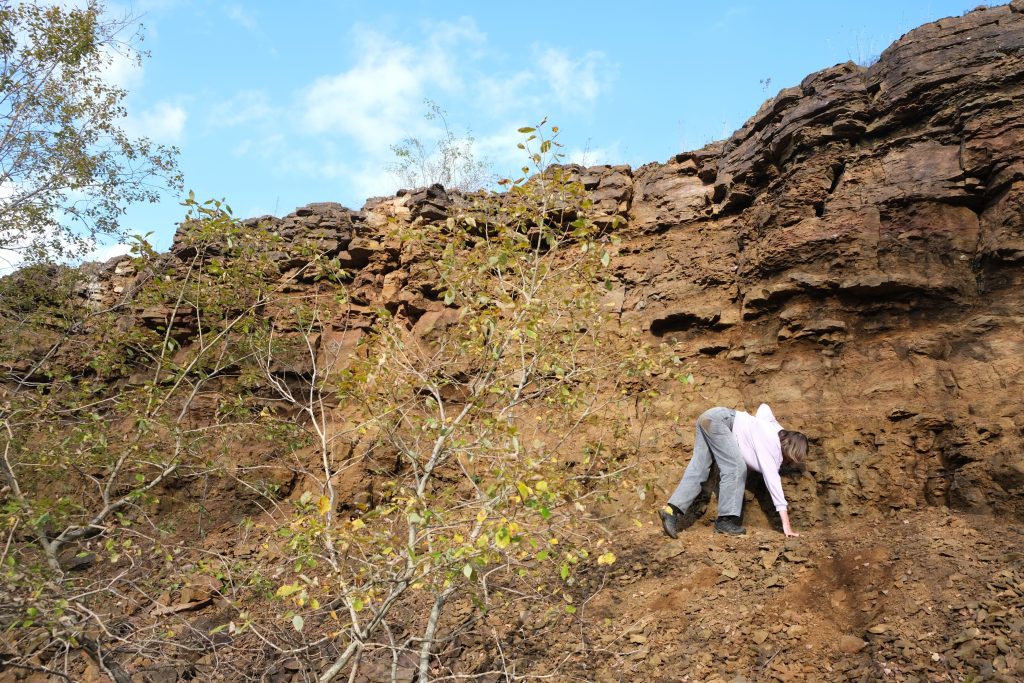
The Minett landscape bears the remnants of open-pit and underground mining, steel complexes, slag heaps, and blast furnaces — the ruinous imprints and ghosts of twentieth-century extractive capitalism. Within this setting, the research is situated in practices of care: sensing, feeling, and learning from and with the earth.
.
Listening-with, or the field of listening
One of our relational practices is listening — inspired by the work of Pauline Oliveros on deep listening, and by the work of Salomé Voegelin. We practice listening by attending to heard and felt sound vibrations: a sonic sensibility that, as Voegelin writes, “reveals the invisible mobility below the surface of a visual world, the layer that shows its relationships, actions, and dynamics.” At the same time, what one hears touches and permeates the listener, immersing them within the sonic volume. Within this enmeshment, as Voegelin writes, “listening generates place; the field of listening, continually from my hearing of myself within the dynamic relationship of all that sounds.”
As you listen, the particles of sound decide to be heard. Listening affects what is sounding. It is a symbiotic relationship. As you listen the environment is enlivened. This is the listening effect. […] Our world is a complex matrix of vibrating energy, matter and air, just as we are made of vibrations. Vibration connects us with all beings and connects us to all things interdependently.
–Quantum Listening, by Pauline Oliveros
.
.
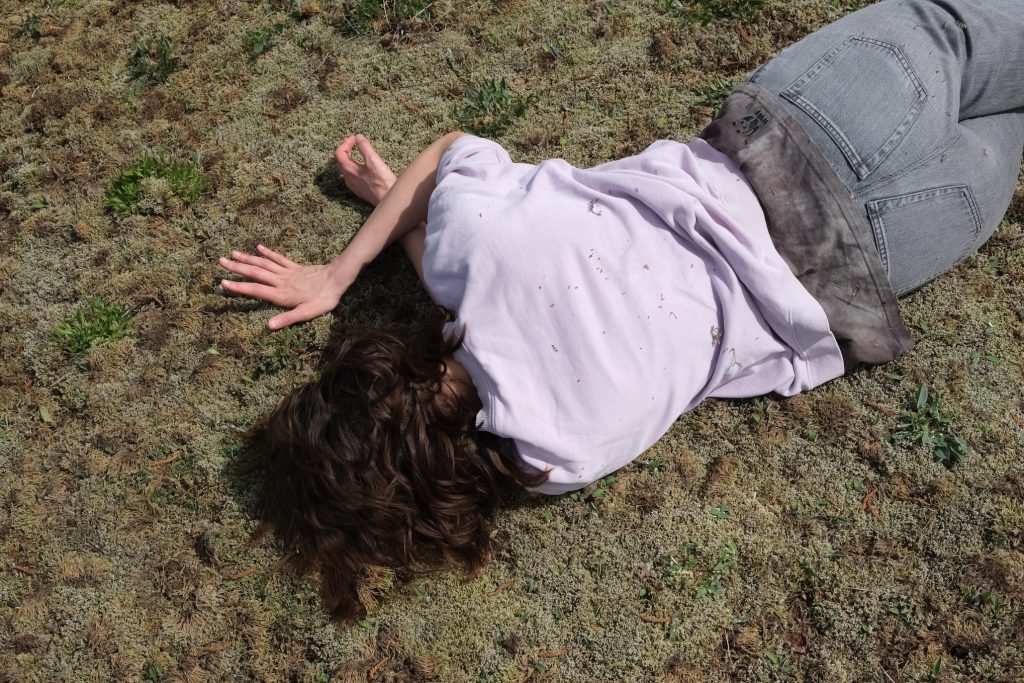
Practicing on moss
.
.
Listening as a multi-sensorial, full body listening-with
Alongside this sonic sensing, listening expanded into a multi-sensorial listening-with one’s whole body and being. Anchored in a somatic sensibility, we practice this embodied extrospection as a particular attention to what is outside oneself while including oneself — so as to deepen one’s attunement to the information, feedback, and intelligences within a place — with the intention of learning to be in conversation with the landscape, perceiving oneself beyond the self as part of the land.
This multi-sensorial listening is mutual: the landscape listening, and oneself listening in return. Anything we touch touches us back.
.
Moving and becoming-with, or dancing the body-landscapes song
Through this mutual listening, sensing, smelling, and seeing — alongside the sensing of one’s own body, movement, and the vibrations of one’s voice — a space opens for transpersonal transformation, allowing a co-becoming with the land.
“working with the body as material of the in- between and in collaboration”
– Salome Voegelin
By way of this reciprocal, multi-sensorial listening to the land, dwelling in its vibrant ecologies — its deep time, present pluralities, and possibilities — we enter a dance with the multi-sensorial song of the land. The word enchantment derives from the French chanter, meaning “to sing.” We allow the affect of this sensory dance to express itself through our voices as a gift back to the landscape: a form of vibrational massage, a relational sounding and singing with the song of the land. Through this sensing, feeling, moving, and voicing-with, we enter the dancing-the-body-landscape song.
.
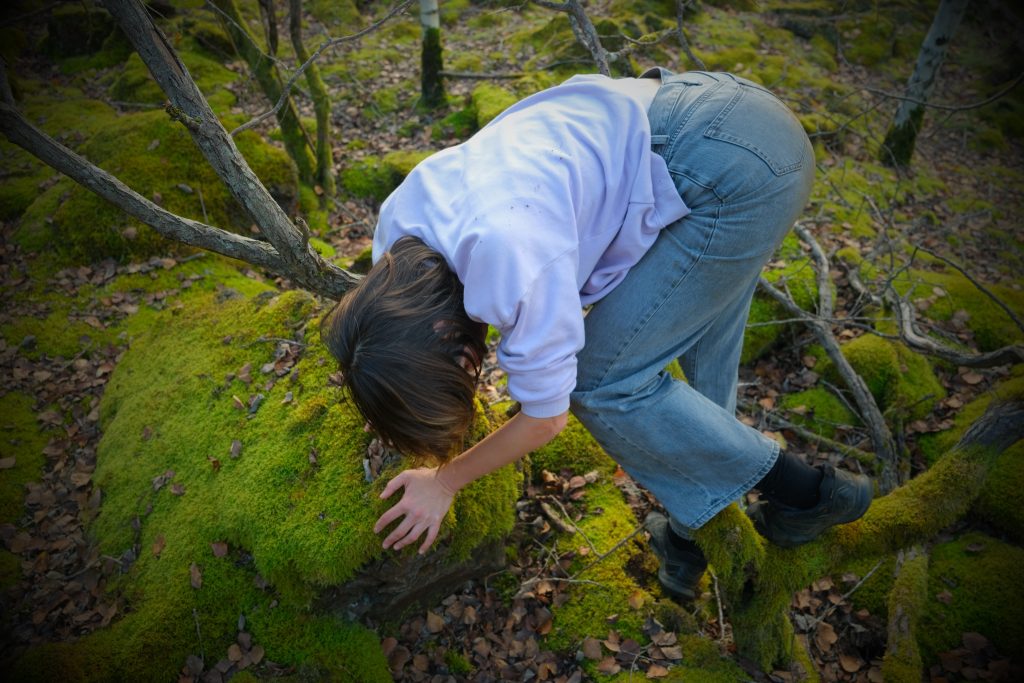
dancing-the-body-landscape song practice on boulders — the piles of leftover rocks from open-pit mining, now covered in moss.
.
The senses as political
Inspired by Bayo Akomolafe’s claim that the senses are political, we approach listening as a political act — one that includes intentionally attending to voices beyond dominant power positions: marginalised voices and the more-than-human alike.
Listening to the landscape’s pluralities and possibilities, hearing the dense multiplicity of its mobile production, allows us to challenge the singularity of actuality and articulate a different sense of place and a different sense of self that lives in those possibilities and shows us how else things could be.
– Sonic Possibilities of Sound, by Salome Voegelin
.
Listening to that which we do not hear — because it is displaced — yet with which we remain entangled.
My interest in deep time — geological time — involves widening awareness and imagination to a terrestrial scale and history, and to long-term thinking. We attempt to discern the near and the far in space and time, tracing connections and gathering information to recompose possible meanings. Deep time helps us consider the movement of and between matter that is not only near or far, but co-constituted. Listening into deep time might reveal the “first musical notes of worlds to come” (Bayo Akomolafe).
Practising this in the Minett — a land haunted by the ghosts of extractive capitalism — invites reflection that reaches beyond the more-than-human and deep time, toward the ongoing harms of extractivism: harms that have not ceased but intensified and been displaced to cheaper places with weaker environmental and human rights protections, or where such protections go unenforced — through land grabbing, the destruction of homes, the pollution of water, air, and soil, and the threatening, imprisonment, and disappearance of environmental activists. > The Real Cost of Steel
.
Influences
The research is informed by decolonial theory, political ecology (including the work of Jane Bennett), new materialism, posthuman feminism (Rosi Braidotti and Donna Haraway), transcorporeality (Stacy Alaimo), and ecofeminism, as well as by practices of listening, walking, sound, eco-somatics and body-land connection. It is also inspired by Shawn Wilson’s notion of research as ceremony, and by certain indigenous cosmologies — among them the Belyuen Aboriginal notion of the Dreaming, as explored in Elizabeth Povinelli’s article “Do Rocks Listen?” — and with the work on relationality of Lauren Tynan, a trawlwulwuy woman from lutruwita/Trouwerner/Tasmania. While the research is nourished by these encounters, it is careful not to appropriate but rather to listen and learn from indigenous thought, remaining primarily concerned with the ancient and ongoing violences of late liberalism (a term borrowed from Elizabeth Povinelli) and neocolonialism on peoples and lands of the Global Majority — through extractivism, toxic dumping, and their many continuations.
.
Intended development of terres rouges, i/we listen with you
This research is expected to grow into a long-term participatory project from 2025 onwards, unfolding through regular walk-and-workshops in the Minett — each a distinct chapter exploring its themes and questions.
.
Who so far
terres rouges, i listen with you has the support of a one-year research grant from the Ministry of Culture of Luxembourg, and is created in exchange with Alexandra Baybutt, Christine Sollie, Salome Voegelin, the land, and others along the way.
.
What so far

17 August 2025
dancing-the-body-landscapes-songs workshop 14.00-17.00 as part of the Land in Motion. Transforming People and Nature Exhibition (LU)

12 July 2025
terres rouges, we listen with you choreographic walk 14.00- 17.00 at Giele Botter, as part of the Squatfabrik residency (LU)> free event, to reserve : inscriptions@kulturfabrik.lu

11 July 2025
terres rouges, we listen with you Squatfabrik Get Out from 18.30 at Kufa (LU)

16 June - 11 July 2025
terres rouges, we listen with you Squatfabrik residency at Kulturfabrik (LU)

21 June 2025
La pierre en quête d'origine - Den Heemwee vum Steen 16.00–18.30 with the D'Kollektiv at Belvaux Galgebierg  (LU)

28 September 2024
terres rouges, i listen with you presentation at ‘ARTZero - Greater Region Zero Emission Art Symposium", under 'Best practice projects and presentation of artistic projects', at Europäische Kunstakademie e.V. Kunsthalle Trier (DE)

August 2024: sharing of the research in situ with Christine Sollie and Alexandra Baybutt.

May 2024: sharing of the research and the sounding-the-body-landscape practice with artists Nora Wagner and Kim El Ouardi within their participatory on the road film project entitled “The Capsule”, and within a residency at Spectrum in Rumelange.

April 2024: geological walks with geographer Nico Graff and with geologist Romain Meyer (Association géologique du Luxembourg), reading the land and its evolution over millions of years, as well as its current regeneration.
How you can help
I am researching local literature, sagas, and folk songs that speak or sing of the Minett land — exploring how the land was perceived, and whether there runs through them an animistic vein, or any expression of gratitude and thanksgiving. If you have any related information or suggestions, they would be most welcome. Please do get in touch — thank you.
vibrantmatterproductions@gmail.com.
Thank you for listening